
- I am assuming that you already know how to create a beam bending moment diagram and you have already calculated all the bending moment values at suitable locations of the beam.
- You have to understand the following basic equation carefully, in order to determine whether the BMD curve will be convex or concave:
dM/dX = Q………………..eqn1.1
Where,
dM/dX – Slope of the bending moment diagram curve
Q – Shear force
- You got the hint? Yes, you are right, at any point on the beam if the shear force value is negative, then the slope of the beam bending moment diagram will also be negative and vice versa.
- What does it mean by negative slope of a curve?
Slope = Rise / Run ……eqn.1.2
You draw a tangent to the given point of the given curve, now, if the value of “Rise” (the Y coordinate) or “Run” (the X coordinate) goes negative, then the slope is negative, or else it is positive.
- Now, refer the following two snaps taken from my previous BMD article :
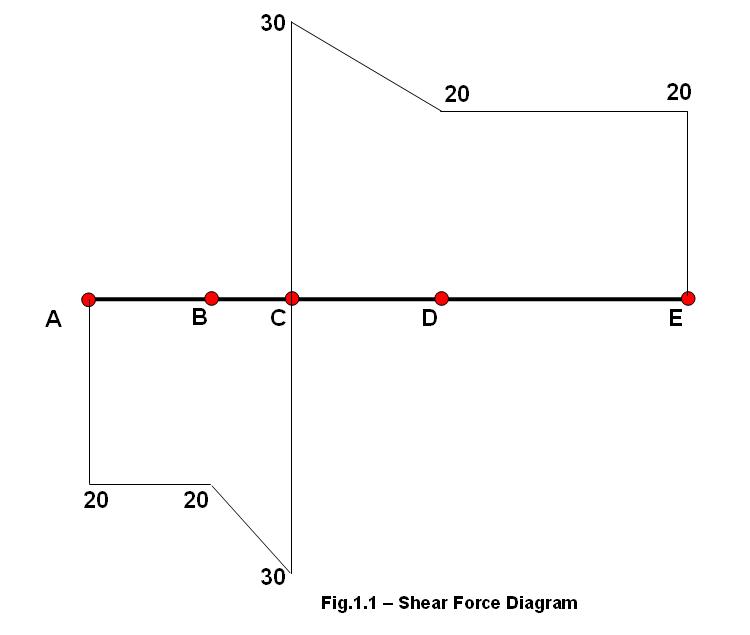


- Observe the tangents, I have created by dotted line below:

- The slopes of the red color tangents are negative and the Shear force value related to the red color tangent is between -20 to -30 (i.e. negative).
- The slopes of the green tangents are positive and so the shear force values related to the green color tangent.
Conclusion
The curvature of the beam bending moment diagram at a point depends on the shear force value at that point. If the shear force value is positive, then the slope of the BMD curve will also be positive and vice versa.

http://www.sopromat.ho.ua/en – online beam calculation (with deflections)
Nice Artcle
Useful!